
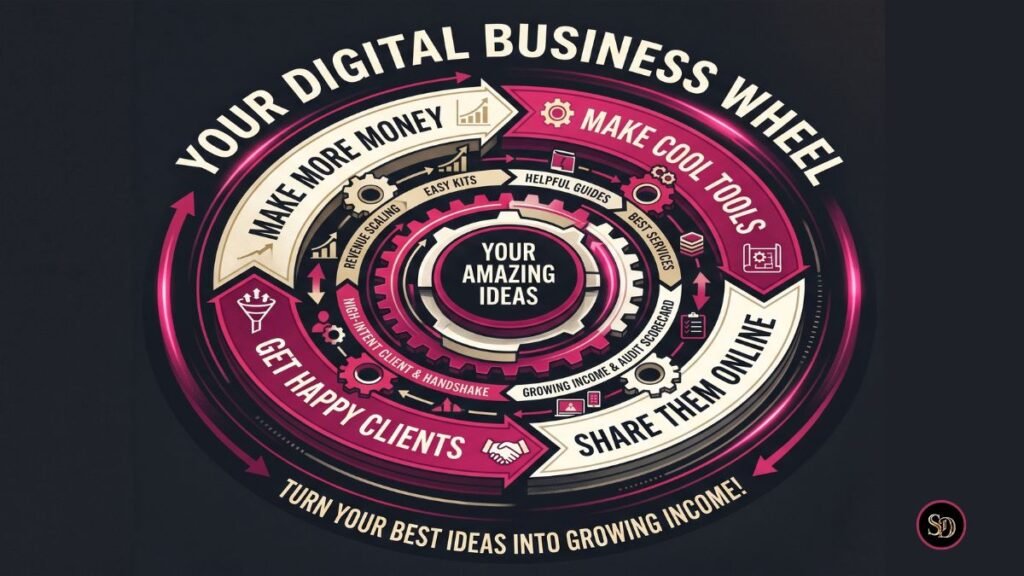
Digital asset ecosystem: I watched this happen for years in home fashion merchandising. Specifically, hundreds of custom hours were treated like disposable labor rather than reusable capital. Consequently, brilliant teams rebuilt everything from zero season after season. Therefore, if you look at your own practice today, you will likely find the exact same leak draining your revenue, because when you sell raw hours, your income stops the moment your calendar closes.
Stop Trading Custom Hours for Disposable Labor: Build Your Digital Asset Ecosystem
Picture this. A brilliant designer spends three weeks building a one-of-a-kind client presentation. The pitch lands. The client signs. And that deck, full of his sharpest thinking, gets filed away and never opened again. It was never part of a digital asset ecosystem.

The Operational Comparison: Custom Labor vs. Packaged Assets
The High-Value Trap: Trading Genius for Hours
Selling advisory hours feels dependable at first. You deliver tailored wisdom, and your clients pay for direct access.
However, this delivery model comes with an invisible trade-off. The moment you stop speaking, writing, or presenting, cash flow pauses. Because your brain is the only delivery vehicle, taking on more clients demands more hours on your calendar. You cannot monetize intellectual property you never package.
Eventually, you hit a hard capacity wall.
Worse, potential clients who aren’t ready for a full five-figure engagement have no way to sample your methodology. They either buy your premium retainer or leave empty-handed.
A well-crafted digital asset ecosystem bridges this exact gap. It captures your hard-won intellectual property once, packages it cleanly, and deploys it repeatedly across your audience.
Why Unstructured Content Cannot Monetize Intellectual Property
Many professionals believe posting commentary on social platforms builds an inbound pipeline. They write thoughtful essays and publish detailed breakdowns.
Yet, free social commentary rarely converts into reliable revenue on its own.
When your best frameworks stay scattered across disparate feeds, they remain unindexed and ephemeral. They help your readers feel inspired, but they do not solve an operational problem.
According to authoritative search guidelines on original perspective and E-E-A-T, structured assets that demonstrate applied utility carry vastly more lasting authority than superficial advice.
An intellectual property asset is fundamentally different from a regular post. A true asset has three distinct properties:
- It is permanently accessible under your owned domain.
- It guides the reader through an actionable, repeatable diagnostic step.
- It clearly demonstrates the commercial value of working with you directly.
Three Tiers That Turn Your Expertise into Revenue
To turn your knowledge into an inbound asset engine, try packaging proprietary frameworks into three balanced levels:

Tier 1: The Diagnostic Entry Point: This is your low-friction diagnostic tool or foundational blueprint. Think of an onboarding diagnostic, a pricing calculator, or an audit scorecard. It solves one specific friction point immediately. It gives the buyer a fast win while proving the caliber of your standards.
Tier 2: The Self-Guided Transformation: This tier packages your end-to-end framework into a self-paced operational suite. Instead of booking you for ten hours of preliminary setup, the client utilizes your proprietary templates, standard operating procedures, or strategic roadmaps. They receive your exact thinking at an accessible price point, and your calendar remains untouched.
Tier 3: The High-Touch Advisory: At this level, you deliver custom implementation, private counsel, or comprehensive design direction. For example, they understand your language, respect your methodology, and arrive pre-sold on your value. They understand your language, respect your methodology, and arrive pre-sold on your value.
Turning Scattered Ideas into an Operational Engine
Building a digital product ecosystem for advisors does not require inventing an entirely new business. It simply requires looking closely at the work you already deliver.
Start by identifying the diagnostic step you repeat with every single client. Perhaps you audit their brand positioning. Maybe you re-architect their website layout, or streamline their client onboarding sequence?
Take that repeatable step and translate it into a structured resource. Document the criteria. Provide the scorecard. Design the template with the same care and visual elegance you bring to private client deliverables.
Your assets do the heavy lifting of educating, qualifying, and attracting clients for you.
Strategic Asset Showcase: The Executive Client Diagnostic Suite

Stop rebuilding your onboarding and diagnostic audits from scratch. Download our structured, high-converting onboarding template suite to evaluate client readiness, clarify scope, and elevate your brand perception from day one.
The Verdict
AI will not reward the loudest founder. It will reward the clearest one. So do not chase every trend. Instead, build a name that Google can recognize, clients can remember, and AI can trust. That is personal branding for executive founders at its best. Quiet. Specific. And built on proof.
With calm confidence,
Suzanne
P.S. Try this 30-second check. Google your name. Then ask AI who helps with your client’s biggest branding problem. If your name is missing, you do not have a content problem. You have a perception gap. That is exactly what my Executive Diagnostic Audit is designed to uncover.