
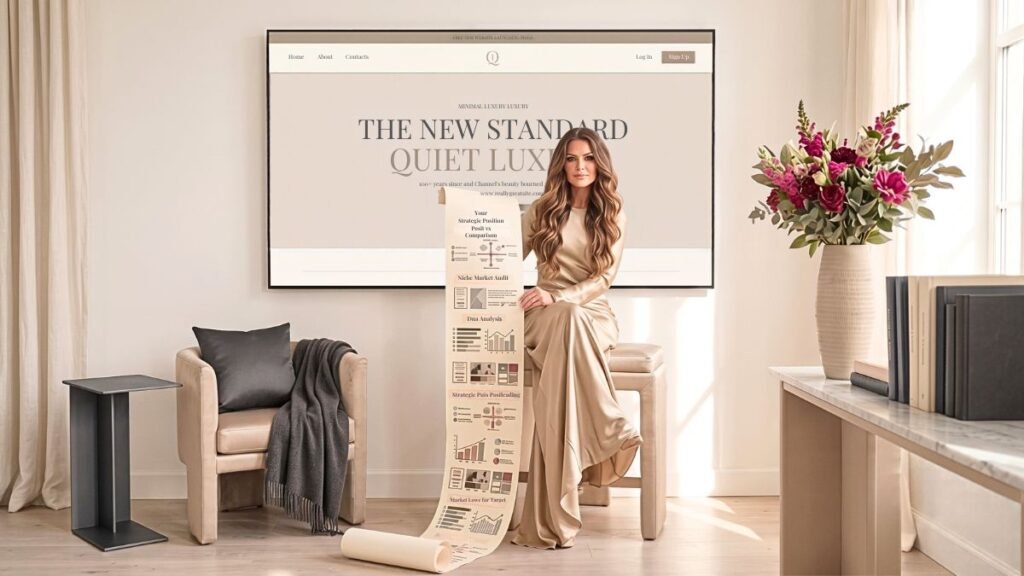
Brand Messaging Strategy: 7 Ways to Attract Premium Clients
When established service entrepreneurs hit a growth ceiling, the bottleneck is rarely capability; it is almost always an outdated brand messaging strategy. In person, your strategic expertise is unmistakable, but online, understated messaging creates an immediate credibility gap.
Years ago, when I served as a Vice President of merchandising in the home fashions industry, I regularly met with top retail buyers.
Our product development team had spent months refining thread counts, sourcing European textiles, and perfecting stitch margins. Yet, during one pivotal line review, a senior merchandise director paused and looked across the mahogany table at me.
“Sue,” he remarked candidly, “this catalog lists eighty technical features, but you haven’t told me why my customer should care.”
That conversation permanently reshaped how I view commerce. The issue was never our quality; our quality was impeccable. The real problem was that our narrative was cluttered with functional minutiae instead of emotional clarity.
Today, I observe the identical pattern among seasoned female founders, boutique practice owners, and executive advisors. You deliver exceptional, life-altering outcomes for your clients every day. Yet, when an executive lands on your website, your copy lists operational tasks like a job resume.
I call this the Expertise-to-Perception Gap. Your capability is an undisputed 10 out of 10, but your digital messaging explains your services like an entry-level practitioner.
A clear brand messaging strategy fixes this issue immediately. When you articulate your distinct value with precision, fee negotiation vanishes, and premium clients recognize your authority instantly.
1. Audit Your Brand Messaging Strategy for Visual and Verbal Friction
The Real-World Parallel
When you schedule a transatlantic flight, you do not examine the turbine mechanics or ask to inspect the fuselage rivets. You simply want to know that you will arrive safely, comfortably, and on schedule.
High-caliber clients behave the same way. Stop detailing your tactical tools. Instead, focus entirely on the operational calm and clarity you produce.
2. How to Talk About Your Services by Leading With Strategic Direction
How to Talk About Your Services With Strategic Authority. When business owners experience a growth plateau, they frequently make the mistake of broadening their message. They reason that speaking to everyone broadens their opportunity pipeline.
An intentional brand messaging strategy stops competing on mere deliverables and anchors your unique perspective.
However, the reverse is true. When you write copy for everyone, high-value decision-makers scroll past. Discerning corporate leaders and private clients have specialized, high-stakes challenges. They are not searching for a generalist; they require a specialist who understands their precise terrain.
Notice the Contrast
- Generalist Framing: “I provide strategic business consulting and advisory services to ambitious leaders.”
- Definitive Framing: “I counsel boutique legal practice founders, wealth advisors, and private clinical directors who are ready to break through their revenue ceilings.”
The second statement signals instant peer-level credibility. When a private practice owner reads that line, they recognize immediately that you understand their world.
3. Position Your Story to Serve Your Client
Take an objective look at your About page. Does it read as a chronological catalog of job titles, educational degrees, and past accomplishments?
That structure is standard, yet it overlooks human psychology. When a prospective client reads your story, they are seeking reassurance on one point:
“Does this person possess the exact insight required to solve my bottleneck?”
How to Reframe Your Background
Transform your personal trajectory into clear evidence of your strategic capability:
- Acknowledge the Industry Friction: Detail the exact frustrations and operational noise your ideal clients face right now.
- Present Your Perspective: Explain why conventional approaches in your field consistently fail to solve that friction.
- Offer Your Experience as Proof: Share your career milestones, but frame them as the reason you can reliably guide them to their desired outcome.
Your professional track record is your greatest differentiator. When you present it with restraint and relevance, trust develops naturally.
Free Strategic Guide: The Persuasive Sales & Brand Identity Masterclass
If you struggle to articulate the true value of your high-ticket offerings, you are not alone.
Download our complimentary, step-by-step masterclass framework. You will learn the exact verbal and visual shifts required to turn casual website visitors into committed, high-paying clients.
4. How to Talk About Your Services by Leading With Strategic Direction
In behavioral psychology, people do not move when things are mildly inconvenient. They move when remaining in place becomes too expensive or painful.
Yet, most professional websites talk only about positive outcomes. They talk about “growth,” “alignment,” and “unlocking potential.” Those words sound nice, but they carry no urgency.
During my time directing retail collections, we never pitched a new concept simply because it was attractive. We pitched it because relying on stagnant floor inventory cost the store real retail dollars every week.
Your advisory practice operates on the same principle. If a prospective client does not understand the financial or personal cost of delaying a decision, they will delay it indefinitely.
How to Address the Friction
Instead of offering general advice, point directly to their hidden operational costs:
- Name the daily leak: “Every month your digital presence looks generic, your best corporate prospects quietly choose your competitors.”
- Highlight the executive drain: “Managing broken, manual booking processes costs your leadership team ten hours of high-value billable time every week.”
When you clearly outline the cost of doing nothing, taking action becomes the only logical choice for your client.
5. Replace “Free Discovery Calls” with a Structured Diagnostic
Nothing devalues a high-end advisory practice faster than an open-ended “free consultation.”
When your main call to action is a complimentary 30-minute chat, you attract bargain hunters and energy drainers. Furthermore, you signal that your strategic time is readily available without prerequisites.
Experienced corporate leaders never walk into meetings without clear agendas. They respect boundaries, clear criteria, and deliberate structure.
Replacing free calls with a structured diagnostic is a fundamental pillar of an executive brand messaging strategy.
How to Shift Your Inquiry Process
Instead of offering casual phone chats, reposition your entry point as a formal assessment:
- Require an Application: Ask three or four thoughtful diagnostic questions before confirming any appointment.
- Cap Your Intake: Keep your calendar selective by limiting private assessments to a strict monthly quota (such as six clients per month).
- Offer Specific Insights: State exactly what decisions will be made during that initial working conversation.
An aligned brand messaging strategy ensures your digital presence reflects the true depth of your expertise.
When you treat your consultation as a structured assessment rather than an open pitch, your prospective clients view you as an authority before the session even starts.
6. Elevate Your Visual Restraint to Signal Quiet Authority
In high-end positioning, what you leave out speaks louder than what you cram in.
Amateur branding shouts for attention with clashing color palettes, cluttered badges, and walls of dense text. High-earning founders and sophisticated clients do not respond to noise; they respond to composure. When a website feels crowded, it signals panic—an underlying anxiety that if you don’t explain every single detail at once, the client will walk away.
True authority practices the discipline of white space. Space is not empty or wasted real estate; it is a strategic asset that directs the eye, commands focus, and signals immense confidence in the caliber of your work.
How to Apply Editorial Restraint:
- Embrace Generous Negative Space: Increase your margins and section padding by at least 20%. Give your strategic ideas room to breathe, treating your site layout like an editorial publication rather than a promotional flyer.
- Commit to a Controlled Color Palette: Limit your brand palette to one dominant foundation, two balanced neutrals, and one subtle accent tone. Consistency builds instant cognitive recognition.
- Pair Power with Clarity in Typography: Combine an authoritative editorial serif for headlines with a clean, highly legible sans-serif for body copy. Maintain a strict visual hierarchy so readers can scan and absorb your value in seconds.
When your visual presence carries effortless restraint, you never have to convince clients of your value—your aesthetic has already closed the perception gap before they read a single line of copy.
7. Anchor Your Brand Messaging Strategy to Clear Economic ROI
When speaking to established founders and boutique practice leaders, soft promises like “finding your voice,” “alignment,” or “reaching the next level” fail to generate momentum.
According to research published by Think with Google, executive buyers make decisions based on risk reduction, collective trust, and demonstrated commercial value long before they ever enter a sales conversation.
High-caliber clients do not invest in your creative process, your tools, or your hours; they invest in certainty, risk reduction, and competitive advantage. When your messaging describes deliverables rather than commercial impact, clients evaluate your services as a discretionary operational expense rather than an essential investment.
To command four- and five-figure engagements with ease, your brand messaging strategy must anchor your expertise directly to economic outcomes.
How to Frame Economic Value:
- Quantify the Friction of Inaction: Clearly outline what staying stagnant actually costs them in missed enterprise contracts, prolonged sales cycles, or brand dilution.
- Lead With Commercial Impact: Frame your work around the tangible business results it produces, accelerated client acquisition, premium market positioning, and higher close rates.
- Eliminate Task-Based Descriptions: Never price or position your services around deliverables like pages designed, hours spent, or style guides delivered; frame the entire engagement around the value of the completed transformation.
When your positioning directly connects sophisticated design with strategic commercial results, price resistance fades. Premium clients readily understand that securing top-tier guidance is far less expensive than the long-term cost of looking like an amateur.
Next Steps: Eliminate the Expertise-to-Perception Gap

In person, your authority is unmistakable. Online, however, understated positioning and visual noise quietly cost you high-caliber engagements.
When your digital presence fails to match the caliber of your counsel, premium clients hesitate, not because of your capability, but because your digital storefront signals friction rather than executive certainty.
Closing this gap does not require louder marketing; it requires strategic restraint and commercial alignment.
The Luxury Growth Audit ($350 CAD)
A private diagnostic assessment of your client-facing ecosystem, designed specifically for established female founders and boutique practice leaders ready to command premium pricing power.
- The Positioning Review: A line-by-line evaluation of your messaging to eliminate task-based descriptions and articulate true economic ROI.
- The Visual Restraint Check: Identifying credibility leaks, visual clutter, and layout friction that dilute perceived authority.
- The Strategic Roadmap: A concise, step-by-step video diagnostic and executive blueprint detailing the exact changes needed to convert sophisticated visitors into committed clients. Delivered directly to your inbox within 3 to 5 business days.
Stop letting an outdated digital presence underprice your actual depth.
Schedule Your Luxury Growth Audit
Warmly,
Suzanne Dufault
Brand Strategist & Creative Director
Where VP-Level Strategy Meets High-End Design.
sue@suzannedufault.ca
P.S. Over a decade in corporate merchandising and sixteen years guiding design practices taught me one non-negotiable rule: true luxury never over-explains.
Here is a quick diagnostic for your next coffee break: pull up your home page on your phone. Does your primary headline immediately anchor your commercial value to an executive decision-maker, or does it describe your creative process like an entry-level service?
The difference between the two is where premium revenue is won or lost. If you’d like a second pair of eyes on what you find, send your link directly to sue@suzannedufault.ca.